Dining in the Dark: Why America's Power Players Are Abandoning Restaurant Tables for Private Sanctuaries
Dining in the Dark: Why America's Power Players Are Abandoning Restaurant Tables for Private Sanctuaries
For decades, the power lunch carried an almost mythological weight in American professional culture. A corner table at a celebrated Manhattan restaurant, a carefully chosen bottle of wine, the subtle theater of being seen — these were the rituals that signaled arrival. Yet something has shifted beneath the surface of that tradition, quietly but unmistakably. Across cities from Chicago to Los Angeles, from Dallas to Washington, D.C., a growing cohort of influential professionals is trading the public dining room for something far more deliberate: the private member club.
This is not simply a matter of preference. It is, by all indicators, a recalibration of what power looks like in post-pandemic America.
The Limitations of the Open Dining Room
Restaurants, for all their atmosphere and culinary artistry, carry an inherent vulnerability that serious professionals have long tolerated but never fully embraced. Conversations travel. Neighboring tables listen. Photographers linger near entrances. In an era defined by instantaneous information and reputational risk, conducting meaningful business in a public space carries costs that simply did not register as acutely twenty years ago.
The pandemic accelerated a reckoning that was already underway. When restaurants shuttered and the rituals of professional dining collapsed overnight, many executives discovered something unexpected: the absence of those rituals did not disrupt their most important relationships. What sustained those relationships was something deeper — shared trust, curated community, and consistent access to peers of genuine caliber. The restaurant had always been a stage. The question became what lay behind it.
Private member clubs answered that question with considerable authority.
Discretion as a Strategic Asset
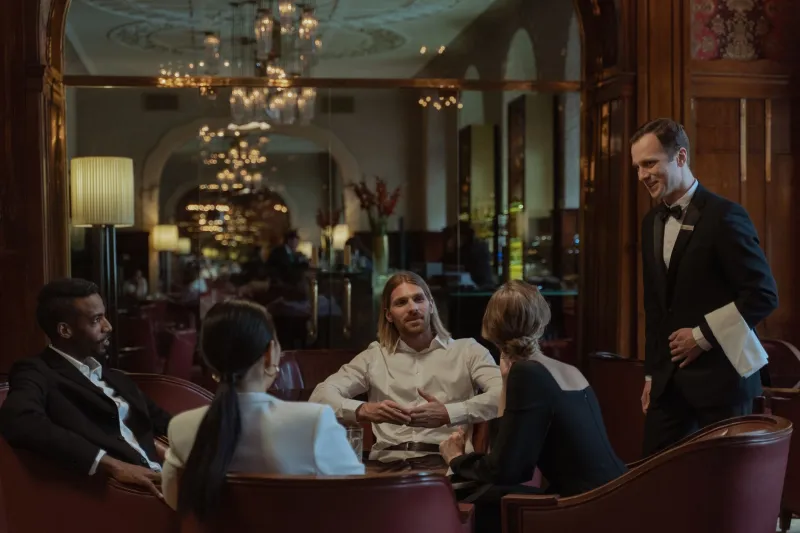
Within the walls of a well-run private club, the dynamics of a professional encounter change entirely. There are no walk-in guests. No opportunistic introductions from strangers. No ambient noise engineered to keep tables turning. What exists instead is a carefully maintained environment in which every individual present has been vetted, accepted, and invested in the community around them.
For members, this discretion is not a luxury — it is a precondition for the kind of candid conversation that actually moves the needle. Mergers are not announced over appetizers at a busy brasserie. Partnerships are not structured where a journalist might be seated two tables away. The private club provides something the finest restaurant in America cannot manufacture: genuine privacy, underwritten by institutional trust.
Industry observers have noted that this dynamic has become particularly pronounced among professionals navigating sensitive sectors — finance, technology, law, and government-adjacent consulting — where the stakes of an overheard remark are not merely social but potentially legal or financial.
The Curation Advantage
Beyond privacy, the private club offers something even more valuable to the discerning professional: a pre-filtered network. Every member in the room has cleared a threshold. They have been introduced, considered, and welcomed by an institution that takes its community seriously. That shared vetting creates an immediate, unspoken credibility that no restaurant reservation can replicate.
This is the element that separates the private club experience from even the most exclusive public dining establishment. A celebrated restaurant may attract the prominent and the powerful, but it also attracts anyone willing to pay the price of a reservation. A private club, by contrast, is a community — one with standards, with history, and with a collective identity that its members actively uphold.
For those who have spent years building reputations and relationships, the ability to walk into a room where the baseline quality of every interaction is elevated is not a small thing. It is, in the estimation of many members, among the most tangible returns on their membership investment.
Atmosphere That Commands the Moment
There is also the matter of environment. The finest private clubs in America have spent generations — and, in some cases, more than a century — cultivating spaces that communicate gravitas without effort. The architecture, the service culture, the quiet attention to detail: these elements do not merely accompany a meal. They frame it, giving every conversation a weight and intentionality that the average restaurant interior, however beautifully designed, struggles to achieve.
This atmospheric advantage has not been lost on a younger generation of members who might once have been drawn exclusively to the newest restaurant opening or the most talked-about chef's table experience. Increasingly, professionals in their thirties and forties are recognizing that the setting in which a relationship is cultivated shapes the relationship itself. To invite a prospective partner, investor, or collaborator into a private club is to make a statement about how seriously one takes the encounter — and about the circles in which one operates.
Status Redefined in the Post-Pandemic Era
The pandemic did more than disrupt dining habits. It compressed timelines, clarified priorities, and forced a broad reassessment of what professional prestige actually means. The corner office lost some of its symbolism as remote work normalized. The public display of dining at the right restaurant became, temporarily, impossible — and when it returned, it returned to a different cultural landscape.
In that landscape, the private club has emerged as one of the more durable markers of genuine standing. It signals not merely financial success but social credibility — the kind that is conferred by community rather than purchased outright. Membership, particularly at clubs with rigorous admissions standards, communicates that one's peers have vouched for one's character and contributions. That is a form of validation that no restaurant reservation, however coveted, can provide.
At JBO Club, this understanding sits at the heart of what we believe membership should mean. The most meaningful professional relationships are not forged in public — they are built in spaces where the people gathered have chosen one another, where the environment supports genuine exchange, and where the institution itself stands as a guarantor of quality.
A New Architecture of Influence
What is taking shape across American professional culture is not simply a dining trend. It is a new architecture of influence — one in which the private club functions as infrastructure for the relationships that drive decisions, shape industries, and define careers.
The power lunch is not disappearing. It is evolving. And in its evolved form, it looks less like a table at a celebrated restaurant and more like a room where every person present belongs, where the conversation can proceed without reservation, and where the institution surrounding it has earned the trust of everyone within its walls.
For those who understand what is at stake in their professional lives, that distinction is not incidental. It is everything.